 By Bemi Brooks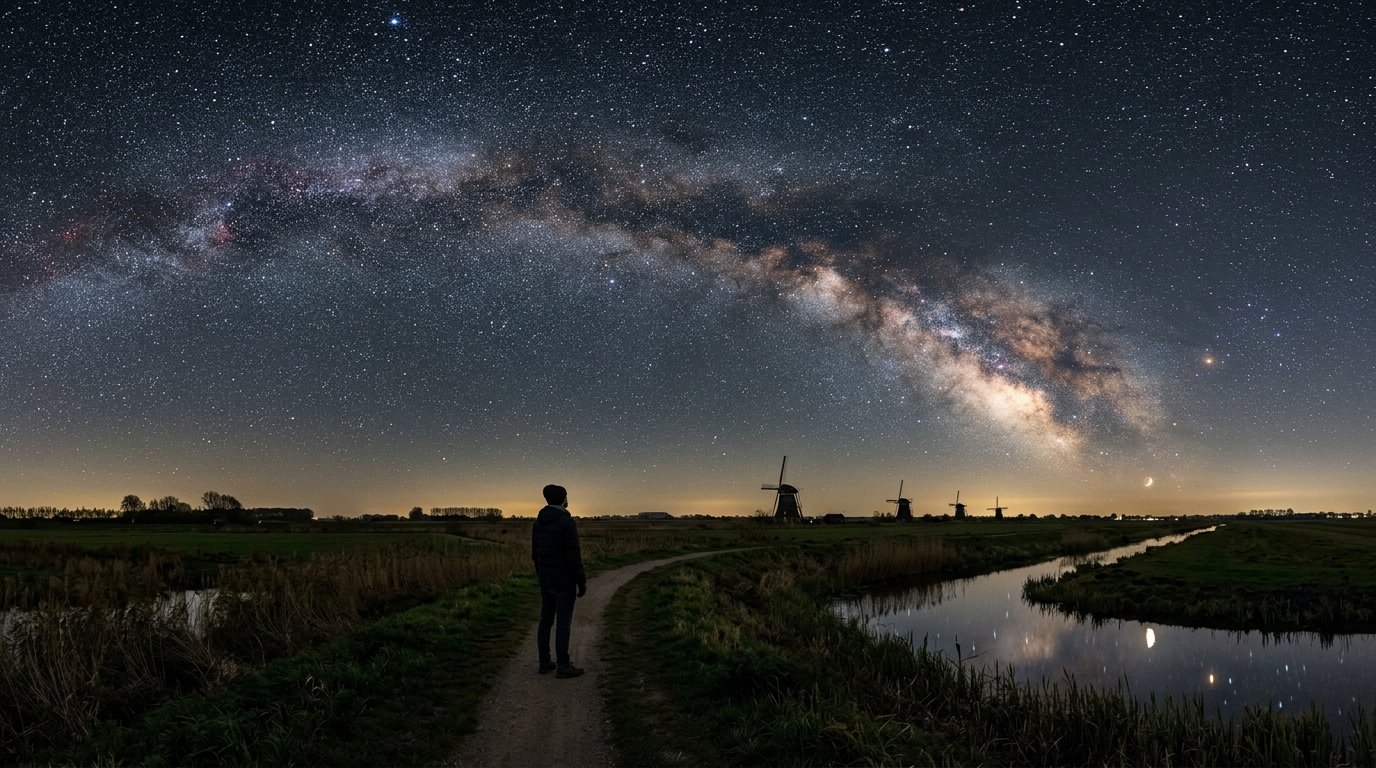
Have you ever stepped outside on a clear night and felt the sky swallow your thoughts whole? The stars stretch farther than any map can hold, and suddenly your inbox, your deadlines, and even your biggest worries shrink into something almost tender. That sensation, that humbling yet oddly comforting pull, sits at the heart of immensheid.
Immensheid is the Dutch word for immensity or vastness, yet it carries more than size. It names the lived experience of encountering boundlessness, whether in a star-filled sky, an open ocean, or the quiet recognition that reality keeps unfolding beyond what we can grasp. In a world drowning in notifications and endless scrolls, this old word offers something fresh: a way to meet the infinite without losing ourselves inside it.
What Does Immensheid Actually Feel Like?
Close your eyes for a moment and picture standing on a high ridge at dusk. The valley below disappears into haze. Above you the first stars prick through. Your body registers both its smallness and its strange belonging at the same time. That double awareness is immensheid in action.
It is not merely “big.” It is the moment when scale stops being a measurement and becomes a feeling. You sense limits you cannot cross and possibilities you cannot count. Many people describe it as a quiet expansion in the chest, followed by a softening of ordinary concerns. The mortgage still exists. The argument from yesterday still happened. Yet both sit inside something larger that refuses to be reduced to problems.
This feeling arrives in ordinary places too. A child staring at a tide pool can meet it. So can an architect tracing lines that seem to run forever across a blueprint. Immensheid does not require a telescope. It asks only that we pause long enough for the ordinary to reveal its hidden depth.
Immensheid Across Philosophy and the Idea of the Sublime
Thinkers have circled this territory for centuries, even when they used different names. In the eighteenth century Edmund Burke linked vastness and infinity directly to the sublime, that mix of awe and slight fear that arises when something exceeds our grasp. Immanuel Kant later split the sublime into two kinds. The mathematical sublime appears when we confront sheer size, like the night sky or the idea of endless time. The dynamical sublime arises when we face power that could overwhelm us yet leaves us intact, such as a storm seen from safe ground.
Immensheid gathers both threads. It lets us feel the mathematical reach of galaxies while also sensing the personal power that comes from simply witnessing them. Existential thinkers later explored what happens when that reach meets daily life. The universe does not revolve around our plans, yet our capacity to notice this fact becomes its own quiet form of freedom. We stop demanding that everything make immediate sense and begin to inhabit the questions instead.
Dutch thought itself carries a long attention to scale. The flat horizons and dramatic skies of the Low Countries trained generations of eyes to hold both intimacy and distance at once. Immensheid simply gives that habit a modern name we can carry into conversations about meaning, creativity, and overwhelm.
How Artists and Creatives Have Always Worked With Immensheid
Artists have never needed the word to work with the reality. Vincent van Gogh’s swirling skies do not just paint stars; they let the viewer feel the sky breathing. Mark Rothko’s large color fields invite you to stand close until the edges dissolve and something wordless opens inside you. Architects have played the same game with light and proportion, designing spaces that make you feel both sheltered and strangely exposed to something greater.
Writers reach for it too. A single sentence can open onto infinite implication the way a window opens onto sea. Photographers chase it every time they frame a lone figure against an enormous landscape. The best creative work does not try to contain immensheid. It creates a small clearing where the vastness can be felt safely.
For anyone who makes things, immensheid becomes fuel rather than threat. When a project feels stuck, stepping back into scale often loosens the knot. The blank page stops looking like failure and starts looking like one more horizon. The same shift helps when commercial pressure or comparison threatens to shrink the work. You remember the larger conversation you are actually in.
Modern Overload and the Unexpected Gift of Immensheid
We live inside more information in a single day than most ancestors encountered in a lifetime. Feeds refresh. Notifications stack. Opinions multiply. The result for many people is a low-grade vertigo, a sense that everything is both too much and never enough. This is where immensheid offers a precise counter-movement.
Instead of adding more content, it invites a different posture toward what already exists. You do not need to understand the entire internet. You only need to remember that the entire internet sits inside something vaster still. That single reorientation reduces the emotional charge of any single headline or argument. It does not make hard things disappear. It changes the room they happen inside.
People who cultivate this perspective often report clearer priorities. Decisions that once felt urgent reveal themselves as small against the longer arc of a life. Relationships gain weight because they become the places where vastness finds a human face. Creativity returns because the mind is no longer trying to outrun infinity; it is collaborating with it.
Practical Ways to Let Immensheid Ground You
You do not need a pilgrimage to feel it. Small, repeated encounters work better than rare dramatic ones. Here are approaches that consistently help:
- Spend ten minutes under open sky at night or dawn without a phone. Let your eyes adjust. Notice what happens to your breathing when the ordinary ceiling of worries lifts.
- Keep a simple notebook for scale questions. After a stressful day write one sentence beginning “In the face of immensheid…” and finish it without editing. The exercise rarely solves the problem, yet it almost always changes the temperature around it.
- Visit places built on grand scale when you can: old cathedrals, long beaches, mountain overlooks. Walk slowly. Let your body do some of the knowing.
- For creatives, begin a session by recalling one image of boundlessness, a Hubble field or a desert horizon, then make something small inside that remembered space. The constraint becomes liberating.
- Talk about it. Mentioning immensheid with a friend or in a journal turns a private shiver into shared language. Language makes the feeling more usable over time.
These are not productivity hacks. They are ways of remembering that you already belong to a larger order. The belonging does not require belief in anything specific. It only asks attention.
5 Quick Takeaways
- Immensheid names the felt experience of vastness, not just its measurement.
- The same feeling that can unsettle us also loosens the grip of everyday overwhelm when we meet it consciously.
- Philosophy and art have long offered maps for this territory; we can borrow them without needing to become experts.
- Regular, modest encounters with scale (sky, sea, silence) build resilience more reliably than occasional grand gestures.
- Grounding does not mean shrinking the universe to human size. It means letting human life sit honestly inside immensheid without apology.
Immensheid does not promise answers. It offers better questions and a steadier place to stand while you ask them. The architecture of infinity keeps rising around us whether we notice or not. The choice is whether we will keep our eyes open inside it.
What moment of scale or boundlessness has stayed with you lately? Try naming it this week, out loud or on paper, and see what shifts.
You May Also Like: What Is Kleptotoxicity? How Some Animals Weaponize Stolen Poison
Frequently Asked Questions
What is immensheid in everyday language?
It is the felt sense of encountering something so large or deep that it stretches ordinary understanding. Think of the moment a landscape or idea makes you pause and register both your smallness and your connection to something bigger.
Does immensheid always feel overwhelming or frightening?
Not necessarily. While it can include a touch of vertigo or humility, many people experience it as quietly expansive or even comforting once they stop resisting the scale. The feeling often softens ordinary anxiety rather than adding to it.
How is immensheid different from simply feeling insignificant?
Insignificance usually carries a sting of worthlessness. Immensheid includes that awareness of scale yet pairs it with belonging or wonder. You remain small, yet you are not therefore meaningless. The two experiences live close together but are not the same.
Can thinking about immensheid help with information overload or digital fatigue? .
Yes. By placing the constant stream of updates inside a much larger frame, the urgency of any single piece of information tends to drop. Many people find they return to screens with clearer boundaries and less reactive attention.
Which philosophers or traditions come closest to this idea?
Ideas of the sublime in Burke and Kant, Pascal’s reflections on infinite spaces, and certain strands of existential thought all circle similar territory. Immensheid simply gathers these threads under a single, accessible word rooted in Dutch.
How can artists or writers use immensheid in their work?
They can treat it as both subject and atmosphere. Instead of forcing every element to resolve, they leave room for the viewer or reader to feel scale. Vast skies, repeating patterns that suggest continuation, or open compositional space all invite the experience without explaining it away.
Is immensheid only about nature and outer space?
No. While nature and cosmos offer the most immediate encounters, the same quality appears in abstract thought, emotional depth, creative processes, and even certain architectural or musical experiences. Any realm where boundaries dissolve can carry immensheid.
What if I try to feel it and nothing happens?
That is completely normal. Immensheid is not a performance. It often arrives sideways when you are not chasing it, during a walk, a quiet moment, or after putting the phone down. Consistency matters more than intensity. Keep offering yourself small openings and the moments accumulate.