 By Arthur
Every single day, your brain faces an absolute avalanche of data. From social media algorithms shaping your feed to complex research projects at school, the ability to process, question, and evaluate information is the ultimate superpower. This isn’t just about getting better grades or winning debates; it is about building high-level analytical skills that help you see through misinformation, make smart decisions under pressure, and solve real-world problems.
Critical thinking is a muscle, and just like any muscle, it requires regular workouts to stay sharp. When academic workloads become overwhelming, many students look for external support, turning to top-tier assignment help websites such as myassignmenthelp to keep up with intense deadlines. However, sharpening your own cognitive toolkit is what ensures long-term intellectual independence. By training your mind to look past the surface of things, you learn to process facts deeply rather than just memorizing them.
The Core Foundations of Analysis
Before diving into the exercises, it helps to understand what happens when you think critically. True analysis requires moving away from passive consumption and moving toward active investigation. You must learn to separate what is objectively proven from what is merely assumed.
To help visualize this mental shift, consider the path data takes through your mind:
[ Raw Information ] ──> ( Question Authority/Sources ) ──> [ Identify Biases ] ──> ( Logical Evaluation ) ──> [ Clear Action ]
When you apply this sequence to any problem, you actively protect your mind against bad arguments, emotional manipulation, and weak reasoning.
15 Daily Exercises for Analytical Growth
1. The 5 Whys Technique
Whenever you encounter a problem or a statement, don’t just accept the first explanation. Ask “Why?” five times in a row. For instance, if a project failed, ask why it happened. Then, ask why that specific issue occurred. By the time you reach the fifth “why,” you will usually uncover the absolute root cause of the issue rather than just treating the surface symptoms.
2. Reverse Engineering a Decision
Take a major successful product, a famous historical decision, or even a popular movie plot, and trace it backward. Start with the final result and deconstruct the steps that led up to it. What were the hidden prerequisites? What dependencies had to fall into place? This exercise trains your mind to map out complex cause-and-effect relationships backward and forward.
3. The “Alter Ego” Debate
When you hold a strong opinion on a topic, force yourself to write a three-paragraph argument from the exact opposite perspective. You cannot use weak, easily defeatable arguments for the opposing side; you must make it sound as convincing and brilliant as possible. This forces your brain out of its comfort zone and breaks down confirmation bias.
4. Categorizing Information Inverted
Most people group things by obvious similarities, like putting all history notes in one folder. Try grouping your daily data by differences instead. Find three completely unrelated objects on your desk and write down three hidden connections between them. This patterns-of-recognition exercise helps you find innovative solutions to complex problems.
When university courses shift toward technical subjects, the sheer volume of data analysis can trigger immense stress. Students frequently seek expert help with engineering assignments to handle dense mathematical modeling and structural calculations. This brand of specialized support saves valuable time, allowing you to dedicate your mental energy to understanding the core logical frameworks behind the formulas.
5. Fact vs. Inference Auditing
Take a short news article and read it line by line with two highlighters. Use one color for absolute, undeniable facts (statistics, direct quotes, verified events) and another color for inferences (assumptions, emotional words, interpretations). You will be shocked at how much of what we read as “fact” is actually just clever interpretation.
Cognitive Breakdown: Facts vs. Inferences
| Element | What It Is | Example Statement | Analytical Value |
| Fact | Evidence that can be proven true or false through objective data. | “The company’s profits dropped by 12% this quarter.” | Provides a stable, unchangeable foundation for arguments. |
| Inference | A logical conclusion or assumption drawn from the facts. | “The company’s profits dropped because the manager is lazy.” | Highlights personal bias, emotion, and missing data points. |
6. The “No-Assumption” Day
Pick one day a week where you actively question every assumption you make. When you assume a friend is upset because they didn’t text back, stop and list three alternative logical reasons. When you assume a math problem is too hard, question why you believe that before even trying. This clears out cluttering mental biases.
7. Designing a Conceptual Flowchart
Instead of taking traditional text-based notes, map out your next essay or project using a pure flowchart. Connect ideas using arrows labeled with action words like causes, contradicts, supports, or accelerates. Visually structuring information forces your brain to evaluate the actual strength of the logical links between concepts.
8. The Premortem Analysis
Before you launch a project or submit a major assignment, pretend it has already failed completely. Write down a detailed narrative explaining exactly what caused the disaster. By anticipating risks before they actually happen, you can fix weak spots in your strategy ahead of time.
9. Spotting the Logical Fallacy
Spend fifteen minutes reading through public comment sections or opinion pieces specifically looking for logical flaws. Look out for “Ad Hominem” attacks (attacking the person instead of the argument) or the “Straw Man” fallacy (misrepresenting an opponent’s view to make it easy to attack). Identifying these flaws builds a strong shield against manipulation.

10. The One-Sentence Summary Challenge
Take a complex scientific concept, a chapter of a book, or a detailed news story and try to compress it into exactly one sentence. You cannot use commas to create an endless run-on sentence. It must be short, punchy, and clear. To do this successfully, your brain must separate critical core data from non-essential fluff.
11. Socratic Questioning of Yourself
Turn the questioning inward by auditing your own beliefs. Ask yourself: What is the source of this belief? What evidence would actually change my mind? What are the consequences if I am completely wrong? Intellectual honesty is the foundation of elite analytical thinking.
12. Media Layout Swapping
Read a text-heavy economic or political report, then try to explain it using only three simple hand-drawn diagrams or charts. Conversely, look at a complex infographic and translate its meaning into a clean, text-only description. Moving information between different mediums forces deep conceptual understanding.
13. The Perspective Shift Exercise
When analyzing an issue—like a local environmental policy—evaluate it through three entirely different lenses. How does a business owner look at it? How does a scientist see it? How does a resident view it? Understanding these conflicting priorities helps you build balanced, objective solutions.
Perspective Matrix for Problem Solving
| Target Lens | Core Priority | Primary Concern | Analytical Insight Gained |
| The Economist | Financial costs and efficiency | Budget constraints, ROI, resources | Understands resource limits and practical funding issues. |
| The Scientist | Data accuracy and safety | Long-term impact, proof, facts | Uncovers objective truths independent of human emotion. |
| The Public | Everyday quality of life | Fairness, convenience, community | Reveals human behaviors, emotional stakes, and cultural adoption. |
14. Estimating with Fermi Problems
Fermi problems are questions that seem impossible to solve at first glance because you lack exact data, such as: “How many piano tuners live in Chicago?” Instead of giving up, use logical estimation. Break down the population, estimate the percentage of people who own pianos, and guess how often they need tuning. This builds incredible comfort with ambiguity.
15. The “Red Team” Strategy
When working in a study group or on a personal project, appoint one person (or yourself) to act as the “Red Team.” The sole job of the Red Team is to aggressively hunt for flaws, loopholes, and contradictions in the proposed plan. Welcoming friendly constructive criticism helps you build bulletproof final products.
The Strategy for Spotting Biases
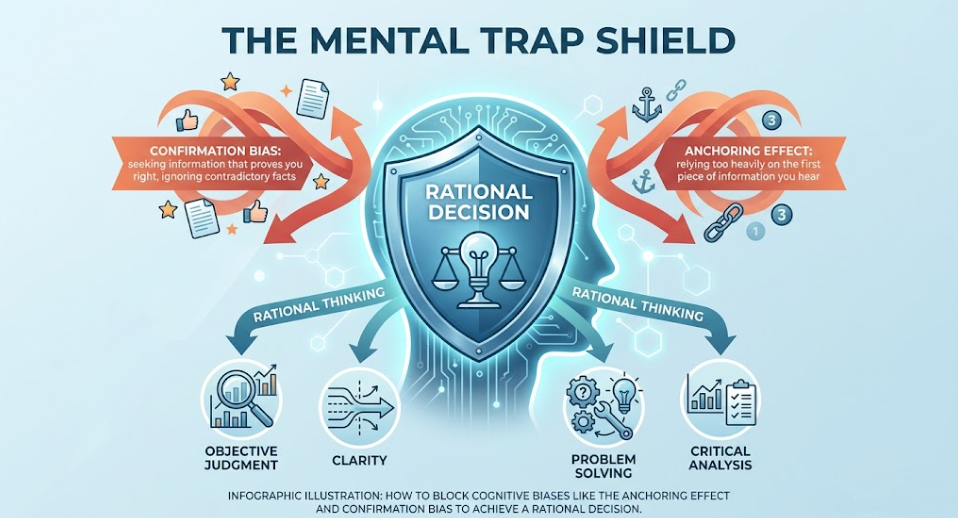
To get the most out of these fifteen exercises, you must learn to recognize the mental traps that cloud everyday human logic. Biases are shortcuts your brain takes to conserve energy, but they often lead to incorrect conclusions.
Mental Trap Avoidance:
[ Raw Idea ] ──> Check against Confirmation Bias ──> Check against Anchoring Effect ──> [ Rational Decision ]
- Confirmation Bias: The tendency to only look for information that proves you are already right, while ignoring facts that prove you wrong.
- The Anchoring Effect: Relying too heavily on the very first piece of information you hear about a topic, even if that data is incomplete or inaccurate.
By combining the daily exercises with a strict awareness of these mental traps, you significantly upgrade your problem-solving speed.
The Compounding Effect of Mental Training
Building sharp analytical skills does not happen overnight. It is the direct result of small, consistent shifts in how you interact with the information around you. By questioning assumptions, breaking down complex data into visual flowcharts, and looking at problems through multiple lenses, you train your mind to think clearly under any circumstances.
Start by picking just two or three of these exercises to practice this week. Write down your findings, map out your arguments, and challenge your own perspectives. Over time, you will notice that you do not just consume information anymore—you truly understand, analyze, and command it.
Frequently Asked Questions
How long does it take to improve analytical skills? You will notice shifts in your thought patterns within a few weeks of consistent practice. Like physical training, mental sharpness compounds over time.
Can these exercises help with exam preparation? Yes. Training your brain to analyze structural relationships and summarize complex ideas makes it much easier to retain and apply academic information under pressure.
What is the easiest exercise to start with? The “5 Whys” technique is a great starting point. It requires no preparation and can be applied instantly to any daily problem or decision you face.
Do I need a group to practice these methods? Not at all. While some strategies work well with teams, the majority of these exercises are designed for individual, independent reflection.